

Feedback
EPSION TECHNOLOGY EPSION TECHNOLOGY EPSION TECHNOLOGY EPSION TECHNOLOGY EPSION TECHNOLOGY EPSION TECHNOLOGY EPSION TECHNOLOGY EPSION TECHNOLOGY EPSION TECHNOLOGY EPSION TECHNOLOGY EPSION TECHNOLOGY EPSION TECHNOLOGY EPSION TECHNOLOGY EPSION TECHNOLOGY EPSION TECHNOLOGY EPSION TECHNOLOGY EPSION TECHNOLOGY EPSION TECHNOLOGY
Product Details
YQX-8 holographic experimental system (basic type)
Holography is a photographic technology that records all the information (amplitude, phase) in the reflected (or transmitted) light waves of the object, and the light reflected or transmitted by the object can be completely reconstructed by recording film, as if the object were there. By observing the photos in different directions and angles, different angles of the object can be seen, so the recorded image can make people produce stereo vision.
Key words:
YQX-8 holographic experimental system (basic type)
Classification:
Hotline:
YQX-8 holographic experimental system (basic type)
Holography is a photographic technology that records all the information (amplitude, phase) in the reflected (or transmitted) light waves of the object, and the light reflected or transmitted by the object can be completely reconstructed by recording film, as if the object were there. By observing the photos in different directions and angles, different angles of the object can be seen, so the recorded image can make people produce stereo vision.
experimental principle and content:
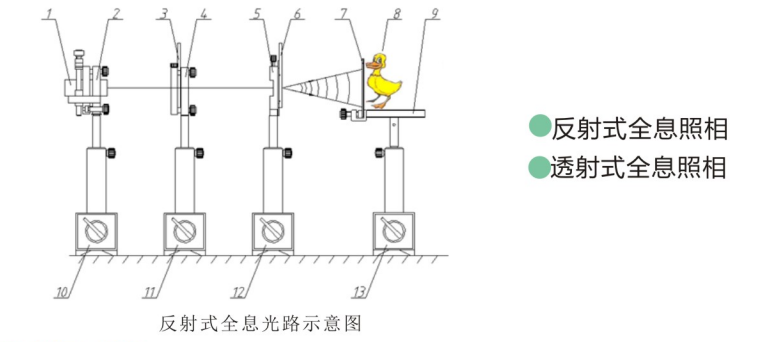
Main configuration and parameters:
| Laser |
semiconductor laser |
| Exposure Timer |
B door, T door, timing, normally open four modes optional |
| optical element |
Beam splitter, plane mirror, etc |
| Lens |
objective lens |
| Clamping tool |
Two-dimensional rack, laser rack, dry plate rack, stage, etc. |
| Adjusting frame |
Universal base, etc. |
| Other components |
Small objects, etc. |
| Platform |
1200*800*200 vibration reduction working platform with anti-vibration working table (various specifications are optional) |
Previous Page
Previous Page
Related Products
The Michelson interferometer is a crucial instrument in physics—it not only confirmed Einstein’s postulate of the constancy of the speed of light, but also demonstrated that light can propagate and exhibit interference without requiring a medium—meaning that the so-called "ether," once thought to permeate space, does not exist. Yet, this groundbreaking discovery simultaneously gave rise to a lingering puzzle in physics (often referred to as "a single dark cloud"): if there’s no ether—no medium—how exactly does light travel? And more specifically, how does light produce interference in the first place? As Albert Einstein once remarked, "I’ve always regarded Michelson as an artist among scientists; his greatest joy seemed to stem from the sheer elegance of the experiment itself and the masterful precision of the methods he employed." To scientists, the Michelson interferometer is not just a scientific tool—it’s also a remarkable work of art. For both functionality and aesthetic appeal, the LGS-2 portable Michelson product comes encased in a sleek, transparent acrylic display box, offering dual protection: it shields the instrument from dust while transforming it into a captivating piece of art. After all, this device aims to balance practical utility with artistic value.
A quantum computer is a machine capable of performing quantum computing, leveraging the principles of quantum mechanics to carry out mathematical and logical operations, as well as process and store information. Theoretically, it is a physical system that uses quantum bits (qubits) as its fundamental storage units, with quantum dynamical evolution forming the basis for information computation. Currently, the main technological approaches can be categorized into six types: superconducting, ion-trap, photonic quantum, neutral atoms, silicon spin, and topological.
YGT-5 diode pumped laser principle experimental instrument
This experimental device takes 808nm semiconductor pumped Nd:yv04 laser as the research object. By setting up the whole experimental system and completing each part of the experiment, it can learn the debugging method of semiconductor pumped laser, observe the frequency doubling phenomenon, measure the threshold, phase matching and other experimental test methods. Deepen the understanding of the basic theory of laser principle and optical frequency doubling technology, and realize the combination of theory and practice. Compared with similar products, this experimental instrument has many functions, can set up many experimental contents, mechanical structure is stable and easy to debug, and the experimental operation is strong.
Experimental instrument for YGT-6 pulsed Q-switched Nd:YAG frequency-doubled laser
This experimental device grasps the basic principle, basic structure, main parameters, output characteristics and adjustment methods of the laser by setting and adjusting the laser by hands, and through observing the phenomena of Q-tuning, mode selection, frequency doubling, etc., learners have a more comprehensive understanding of the principle and technology of the laser. This equipment adopts various protection measures to effectively protect the safety of the operator. A variety of experiments can be set up, allow users to fully understand the principle of laser generation.
Online consultation
We will contact you within one working day. Please pay attention to your email.

Phone/Tel:
E-mail/E-mail:


Epsion, one of the major manufacturers of teaching instruments in China;
Epsion, the inheritor of physics teaching experiment instrument and spectrum analysis instrument in the new era.
HUATAO GROUP
Leave us a message
We will contact you within one working day. Please pay attention to your email.
Copyright©2024 Epsion